Setting up a long-stay RV site or small-home pad
You have the site. Now comes the part nobody photographs: getting level, getting hooked up right, and making the pad livable through heat, humidity and storm season. Here is what to check first and in what order.
The short version
- Level side to side before front to back, then stabilize; jacks steady the rig but do not lift it.
- Match your plug to the pedestal, use a surge protector, and test water pressure before you connect a hose.
- Keep the sewer hose supported with a continuous downhill slope and rinse it before storing.
- Spend the first week walking the site at different times of day to find sun, wind, drainage and dead spots.
On this page
You picked a site, signed something, and now you are staring at a patch of gravel or concrete with a power pedestal and a spigot. This is for anyone settling into a long-stay RV site or a small-home pad in the South or along the coast, where the heat runs long and the rain comes sideways. It walks through the setup in the order that matters, so you spend your money on what keeps you comfortable and safe instead of what looks good in a photo.
Get level first, then get stable
Nothing else works right until the rig sits level. Your refrigerator needs it, your doors stop swinging on their own, and you sleep without sliding toward one wall. Leveling and stabilizing are two different jobs, and mixing them up is how people bend frames.
Start side to side. Put a level on the floor inside, or across a fixed spot like the freezer shelf, and see which way you lean. Drive or back the low-side wheels onto leveling boards or blocks until the bubble centers. Then handle front to back with your tongue jack or front landing gear. Chock the wheels once you are happy.
Only after the rig is level do you drop the stabilizer jacks. Their job is to stop the bounce when you walk around, not to lift anything. Crank them down snug to the ground, no more. If you use them to raise a corner, you twist the frame and crack something you will not notice until later. On a soft pad after rain, put a block under each jack foot so it does not sink.
For a park model or small home on a pad, the same logic applies at a bigger scale: the foundation and piers do the leveling, and you do not improvise with shims under a corner. If the pad itself drains poorly or sits low, raise that with the community before you set anything down. Water has to leave the site, and it will find the lowest point whether you planned for it or not.
Power, water and sewer: the three hookups that run your day
These three connections carry your whole living experience, and each one has a failure mode worth knowing before you plug in.
Power and surge protection
Look at the pedestal before anything else. Long-stay sites usually offer a 50-amp service, sometimes 30-amp, often both on the same box. Match your rig to the outlet, and if you need an adapter, use a proper dogbone rated for the load, not a stack of cheap converters. Flip the breaker off before you plug or unplug.
A surge protector, ideally an electrical management system that also reads voltage, goes between the pedestal and your cord. Campground wiring is not always what it looks like. A miswired pedestal, a low-voltage sag on a hot afternoon when every air conditioner on the loop is running, or an open ground can damage your electronics or your air conditioner compressor. A good unit checks the outlet before it passes power through and cuts off if the voltage drops too low. It is the one piece of gear that pays for itself the first time it trips.
Water pressure and filtration
City water at a campground can arrive at any pressure, and some pedestals push hard enough to blow a fitting or a hose inside your walls. Put a pressure regulator on the spigot before your hose, set to a safe range for RV plumbing. An inline filter after the regulator catches sediment and improves taste. Use a hose rated for drinking water, usually white or blue, never a green garden hose that can leach into what you drink.
In humid heat, keep the hose out of direct sun where you can and drain it before a freeze warning, rare on the coast but not unheard of inland. If you plan to run off your fresh tank instead, that is fine, just sanitize the tank on a schedule and do not let water sit for weeks.
Sewer connection and hose care
The sewer connection is the one people rush and regret. Support the hose along its whole length so it keeps a steady downhill slope from your outlet to the ground inlet. Sagging bellies hold waste and smell. A hose support ramp or a series of supports does the job. Seat the elbow firmly into the ground port and use a donut seal or threaded fitting so nothing leaks or lets odor back up.
Keep your black tank valve closed until the tank is at least partly full, then dump, then flush, then close. Leaving it open lets liquids drain while solids pile up into the mound everyone dreads. Dump gray water after black to rinse the hose. When you break camp or store the hose, rinse it clean, cap both ends, and keep it in a bin away from your fresh-water gear. Cross-contamination is easy and gross. Store sewer and drinking hoses nowhere near each other.
Mail, packages and proving you live here
Long stays create a paperwork problem people forget until a delivery goes missing. Sort out mail early. Some communities have a central mailroom or package lockers; others make you use a nearby box service or general delivery. Ask the office exactly how packages arrive and where they land, because a driver who cannot find site 214 will leave your box at the gate or take it back.
If you are full-timing, many people keep a mail-forwarding service as their legal address for licenses, insurance and banking, and have the important stuff sent there while everyday orders come to the park. Whatever you choose, get your address format right in every account, including the site number, so the label matches what the driver sees. For a deeded lot the address may be a normal street address, which simplifies things; a membership or seasonal arrangement often does not. If you are weighing that difference, our guide to owning a lot in an RV or motorcoach community covers how ownership changes the paperwork.
Shade, mats and mosquitoes: making the outside usable
In the South the outdoors is half your living space for most of the year, and unusable for a few brutal months unless you plan for heat and bugs.
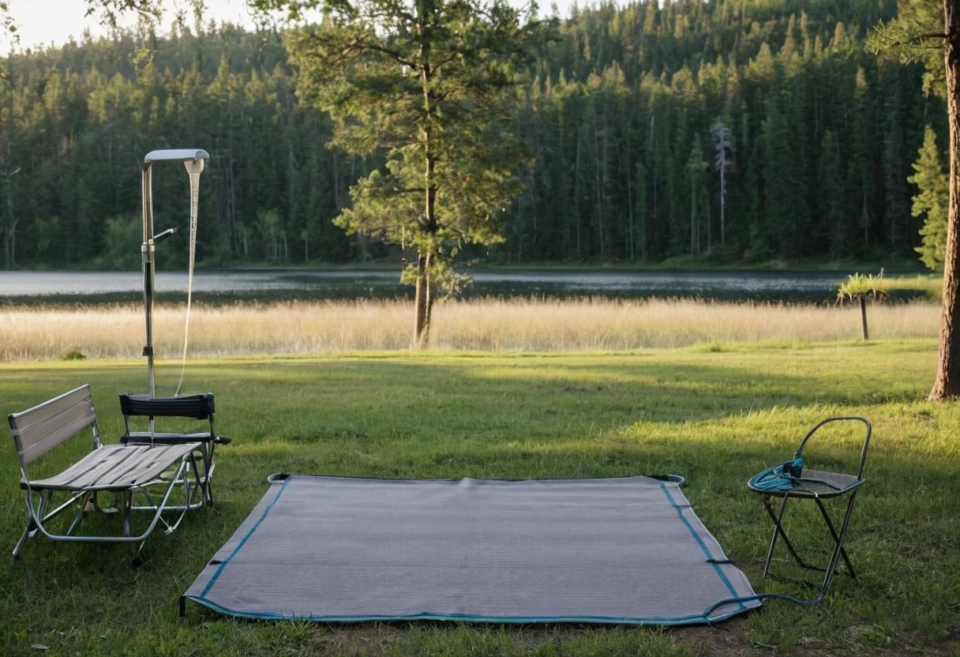
Watch where the afternoon sun lands before you commit to an awning direction or a chair placement. West-facing pads bake from mid-afternoon on. Your awning helps, but a shade sail or a pop-up canopy over the seating area buys you hours. An outdoor mat or rug defines the space, keeps grit out of the rig, and gives bare feet something cooler than concrete. Pick a mat that lets water and sand fall through rather than trapping it, and one you can hose off.
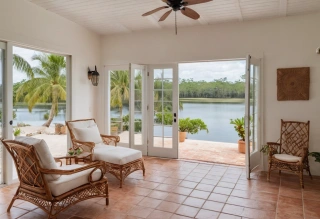
Mosquitoes decide whether you actually sit outside at dusk. Standing water is the enemy, so tip out every saucer, bucket, tarp fold and kids' toy after rain, and check the low corners of your pad where water pools. A fan aimed across the seating area moves enough air to keep weak fliers off you, which is the cheapest trick there is. Screened space beats open space in peak season. If you want a real bug-free room outdoors, a screened porch or covered patio changes the math entirely, and our piece on covered patios and screened porches for hot, humid places gets into roof types, orientation and screens.
Internet that holds up for work
If you work from the road, treat connectivity like a utility, not an afterthought. The park Wi-Fi is shared across every site, and it slows to a crawl in the evening when everyone streams. Test it at the actual hours you need it, not at noon on a Tuesday.
Most remote workers run their own cellular connection through a hotspot or a router with a data plan, and check which carrier actually reaches their site before committing. Signal varies pad to pad, so walk your spot with your phone and read the bars in the room where you will work. A rooftop or window antenna helps a marginal signal. Some people carry two carriers so a dead zone on one does not end the workday. Satellite service is an option in truly remote spots, though trees and storms interrupt it. Have a backup plan for the days the main connection fails, because those days come.
Your first-week checklist and next steps
The first week is for learning the site, not just occupying it. Walk it at dawn, at mid-afternoon and after dark. You will find the sun path, the wind direction, the puddle that never dries, the neighbor's generator, and the cell dead spot faster by watching than by guessing.
- Confirm the rig is level and stabilized, wheels chocked, jacks on pads.
- Test the pedestal with your surge protector before trusting it, and note the breaker location.
- Check water pressure at the spigot, install regulator and filter, and look for leaks at every fitting.
- Seat and support the sewer hose, confirm the slope, and stow spare caps and gloves nearby.
- Set up mail and package delivery with the office and update your address in every account.
- Place shade and seating for the afternoon sun, lay the mat, and clear every spot that holds water.
- Test your internet at working hours and identify your backup connection.
- Find the nearest exit route, the storm shelter or sturdy building, and the office after-hours number.
Once the basics hold, turn to the season you are parked in. On the coast that means knowing your evacuation zone and having a plan before a storm names itself; our guide to getting a small home, casita or RV through hurricane season lays out when to secure the site and when to leave. Write down your utility shutoffs and your departure trigger while the sky is clear, because you will not want to figure them out in the wind. Then go sit outside. You earned the chair.
Written and edited by the Porch & Axle editors. Posted November 28, 2026 in Setting Up.
See something wrong? Email [email protected] or read how we handle corrections.