Storage for full-time RV living: what stays aboard and where it goes
A guide for anyone living full time in a motorhome or travel trailer who needs to fit real life into a small footprint without overloading the rig.
The short version
- Decide what lives aboard before you buy a single bin; everything else goes into storage or gets donated.
- Use latching containers, drawer organizers and vertical space so nothing shifts or spills on travel days.
- Distribute heavy items low and centered in the basement bays, and check your cargo carrying capacity regularly.
- Run a seasonal purge tied to climate changes so clothes, gear and pantry stock stay manageable.
On this page
- Start with what actually needs to travel with you
- Bins, latches and organizers that survive travel days
- Using vertical space without making the rig top-heavy
- The basement bays: heavy, bulky and weather-sensitive
- Kitchen, pantry and clothes for several climates
- Paperwork, medicines and the stuff you cannot replace easily
- A seasonal purge routine that keeps storage honest
If you live full time in a motorhome or travel trailer, every cabinet and bay is prime real estate. This article helps you decide what earns a spot aboard, how to keep it secure on the road, and when to let things go.
Start with what actually needs to travel with you
Before you organize a single drawer, sort your belongings into three piles: daily use, occasional use and stored elsewhere. Daily-use items are the ones you reach for at least once a week. Occasional-use items might be seasonal clothes, a specific tool or holiday decorations. Everything else belongs in a storage unit, a friend's garage or a donation box.
Be honest about frequency. A stand mixer you use twice a year does not need a permanent cabinet slot. A cast-iron skillet you cook in every night does. The goal is to match storage space to actual habits, not aspirational ones.
Once you know what stays, measure your cabinets, drawers and basement bays. Write down the dimensions. You will need them when shopping for bins and organizers, and guessing wastes money and trips to the store.
Bins, latches and organizers that survive travel days
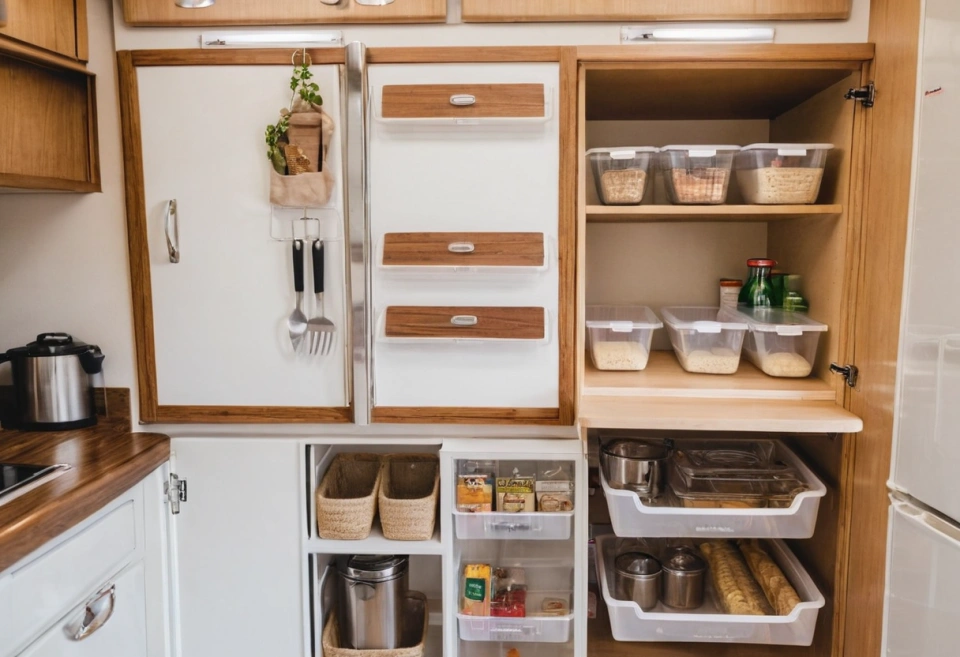
Anything without a lid or a latch will end up on the floor after a rough stretch of highway. Clear plastic bins with snap-lock lids work well in upper cabinets because you can see contents without opening them. Look for bins that fit snugly side by side so they do not slide. A thin shelf liner underneath adds grip.
For drawers, use dividers or small organizer trays that keep utensils, socks or spices from migrating. Tension rods inside a deep drawer create compartments without hardware. In the kitchen, a pull-out pantry rack keeps cans and boxes visible and reachable without digging behind three layers of cereal.
Cabinet doors need child-safety latches or magnetic catches rated for vibration. The cheap adhesive kind peel off in heat. Screw-mounted catches hold up better in the South and along the coast, where interior temperatures climb fast when the rig sits parked.
- Clear snap-lid bins for upper cabinets and bathroom storage
- Drawer dividers or tension rods for utensils, clothes and small tools
- Screw-mounted cabinet latches (not adhesive) for heat and vibration
- Non-slip shelf liner under anything that can slide
- Pull-out racks or lazy susans for deep corner cabinets
Using vertical space without making the rig top-heavy
Wall-mounted hooks, over-door organizers and hanging baskets add storage without eating floor space. A mesh basket hung from a cabinet shelf holds fruit or bread. Over-door shoe organizers work for cleaning supplies, cables or toiletries. Command hooks on a backsplash hold measuring cups or dish towels.
Just remember that weight up high raises your center of gravity. Keep heavy items like canned goods, books and tools in lower cabinets or basement bays. Reserve upper storage for lightweight things: paper towels, snack bags, hats, linens. If you are refreshing your motorhome interior, plan your wall-mount locations before you paint so you can hit studs or backing plates.
The basement bays: heavy, bulky and weather-sensitive
Basement storage is where you put generators, leveling blocks, hoses, grills, folding chairs and extra water jugs. These bays sit low, which is good for weight distribution, but they are not climate-controlled. In the Gulf Coast summer, a sealed bay can get hot enough to warp plastics or degrade batteries. Store heat-sensitive items inside the living space.
Organize bays by function. One bay for hookups and leveling gear. Another for outdoor furniture and recreation. A third for tools and maintenance supplies. Use stackable bins with handles so you can pull the whole bin out rather than reaching into a dark hole. Label the outside of each bin with a paint marker or luggage tag.
Check your rig's cargo carrying capacity (CCC) on the sticker inside a cabinet door or in the owner's manual. Weigh the loaded rig at a truck stop scale periodically. It is easy to creep past the limit one bag of dog food at a time. If you are setting up a long-stay site, you have more flexibility to keep overflow items in a shed or deck box on the pad rather than hauling them everywhere.
Kitchen, pantry and clothes for several climates
A full-time RVer in the US South might see 95 degrees in July and a frost in January. Your wardrobe needs to cover both without filling every drawer. Stick to layers: a few base pieces, a mid-layer fleece, a rain shell and one warm jacket. Roll clothes in drawer organizers instead of folding flat. Rolling compresses fabric and lets you see every item at a glance.
In the kitchen, decant dry goods into square or rectangular containers. Round containers waste corner space. A set of stacking containers for flour, rice, pasta and sugar frees up the original boxes and bags, which take more room and attract pests in humid climates. Keep a small bin of essentials (salt, oil, coffee, a can opener) in an easy-reach spot so you are not unpacking the whole pantry every morning.
For refrigerated items, use small clear bins inside the fridge to group categories: dairy, condiments, leftovers. They slide out as a unit and prevent jars from rolling around on travel days.
Paperwork, medicines and the stuff you cannot replace easily
Important documents (registration, insurance, titles, medical records, passports) should live in a fireproof, waterproof pouch or small lockbox secured inside a cabinet. Keep digital copies on a cloud service as backup. If you carry prescription medicines, store them in a dedicated bin away from heat sources. Many medications lose potency above room temperature, and a parked RV in direct sun is not room temperature.
A small accordion file sorted by category (vehicle, health, financial, pets) keeps paper organized without a filing cabinet. Scan anything you can and shred the original if it is not legally required in paper form. Less paper means less weight and less clutter.
A seasonal purge routine that keeps storage honest
Set a reminder at each season change to walk through every cabinet and bay. Pull out anything you did not use in the past three months. Ask yourself honestly: will you use it in the next three? If not, donate it, sell it or move it to off-site storage. This is not a one-time declutter. It is a recurring habit, like checking tire pressure.
- Empty one cabinet or bay at a time onto a flat surface.
- Sort items into keep, store elsewhere and let go.
- Wipe down the empty space and check for moisture, pests or damage.
- Return only the keep items, reorganizing bins if needed.
- Drop off donations or ship stored items within the same week so they do not pile up on your dinette.
Tie the purge to something you already do: switching out seasonal clothes, winterizing or de-winterizing, or renewing registration. Pairing it with an existing task makes it stick.
Your next step: pick the one cabinet or bay that bothers you most. Empty it today, sort it honestly, and put back only what earns its place. Then schedule the next purge on your calendar before you forget.
Written and edited by the Porch & Axle editors. Posted November 28, 2026 in On Wheels.
See something wrong? Email [email protected] or read how we handle corrections.